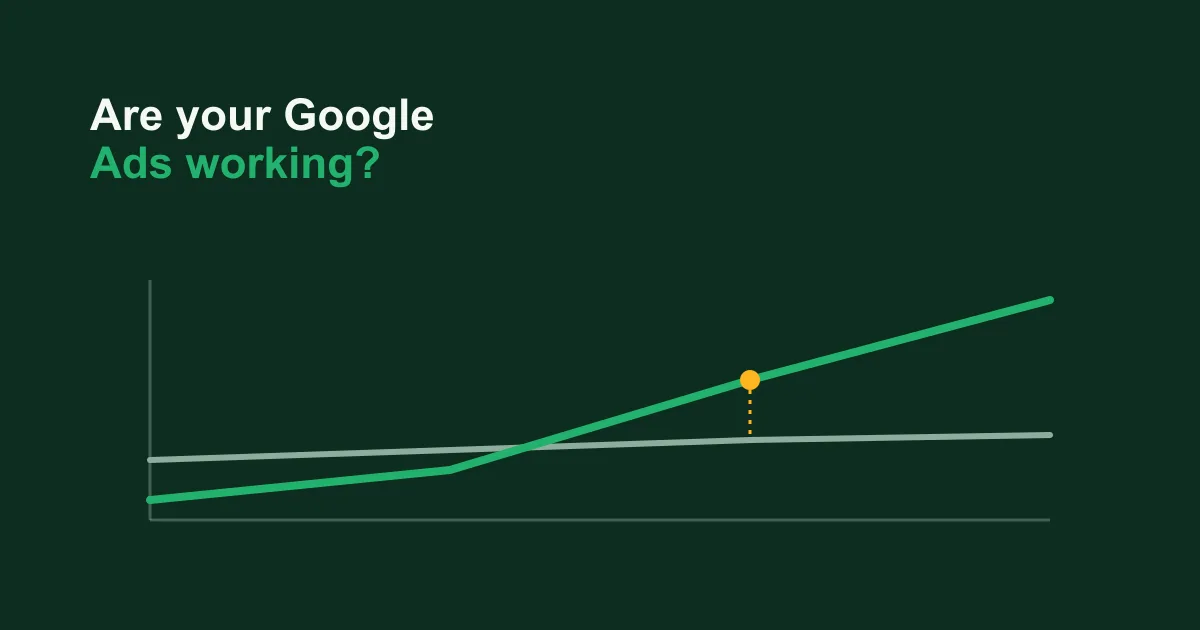
How do you know if your Google Ads are actually working? If you're only looking at clicks, impressions or click-through rate, you don't really know yet — those numbers describe activity, not results. Here's what actually tells you whether a campaign is working.
Start with whether you can measure a lead or sale at all
Before judging performance, check that conversion tracking is even set up properly — tracking a genuine enquiry, phone call, form submission or sale, not just a click to your website. This is the same foundation proper analytics and reporting is built on. Without it, there's no reliable way to know whether the campaign is working; you're judging it on guesswork.
Look at cost per conversion, not cost per click
A low cost per click can look appealing while still being expensive overall if very few of those clicks turn into anything. Cost per conversion — what you actually paid for each lead or sale — is a far more honest number, because it connects spend directly to a business outcome.
Understand return on ad spend (ROAS)
Return on ad spend compares what a campaign cost against the value it generated. This is the metric that ultimately matters, because a campaign with a high cost per click but strong ROAS can still be highly profitable, while one with a low cost per click but poor ROAS is quietly losing money.
Watch for these warning signs
- High click volume but very few or no conversions being recorded
- Conversions being recorded, but at a cost that's clearly higher than what a customer is worth to you
- Spend concentrated on broad or irrelevant search terms rather than ones that match what you actually offer
- No changes being made to the campaign week to week, regardless of performance
Give it a fair amount of time and data before judging
A campaign needs enough data — clicks, conversions, or both — before its performance can be judged reliably. Very early results, especially in the first week or two, can be misleading in either direction. Sensible ongoing review, typically weekly, tends to give a truer picture than reacting to a single good or bad day.
Compare against your own numbers, not industry benchmarks
Generic "average" click-through rates or costs from other industries tell you very little about whether your specific campaign, in your specific market, is working. What matters is whether the cost per conversion makes sense against what a customer is genuinely worth to your business.
FAQs
What if I'm getting conversions but they're not turning into real customers?
That usually points to tracking counting the wrong action — like a page view instead of a genuine enquiry — or the campaign attracting people who click but aren't a real fit. Both are fixable with tighter targeting and more accurate tracking.
How much should I be spending?
There's no single figure — it depends on your margins and what a customer is worth to you. Work backwards from what a customer is genuinely worth, rather than starting from an industry-average number.
Should I just switch to SEO instead if my ads aren't performing?
Not necessarily — the two solve different problems on different timelines. See SEO vs paid advertising for how to think about which fits your situation.
The bottom line
Clicks and impressions tell you a campaign is running — cost per conversion and ROAS tell you whether it's actually working. Make sure genuine conversions are being tracked, judge performance over a sensible period, and measure against what a customer is really worth to you.
Still deciding how paid advertising fits alongside your other marketing priorities? Our guide on what a small business should start with covers the bigger picture.
Want a proper read on whether your current campaigns are pulling their weight? See what our paid advertising service involves, or get in touch for a free audit.